
Still Going Strong at 70: Sparefroh
This year Sparefroh celebrates his 70th birthday. Yet he isn’t old – he keeps up with the times.
Anyone who grew up in Austria probably knows him: the little man with the impish face, the triangular red cap with an Elvis quiff peeking out from under it, a coin for a body and green, bendable limbs. He made his first big appearance on World Savings Day in 1956 and soon became a favourite with children. But where does he actually come from? And why is he called “Sparefroh” – roughly, “happy saver”?
Saving after the war
Many people in Austria had lost their savings more than once, most recently through the Schilling Act of 1945 and the Currency Protection Act of 1947. The savings banks nevertheless held on to the idea of saving: shortly after the war, both school savings schemes (1949) and World Savings Day (1952) were revived. But it was only the stabilisation of the schilling in the early 1950s that gradually restored confidence. As the economy began to recover, savings deposits grew rapidly. For this new, confident kind of saving, the savings banks were looking for an image.
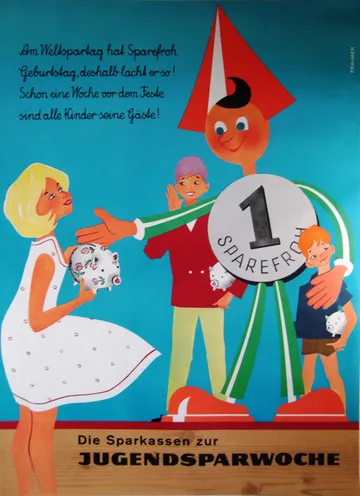
Sparefroh poster by Heinz Traimer, 1956
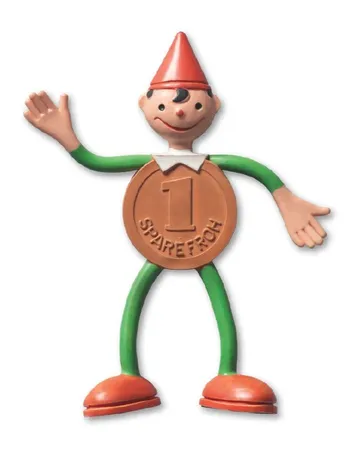
Original Sparefroh figure from Germany, 1955
Arrival from Stuttgart
They found it in Germany. Sparefroh had first appeared there in “Unser Freund” (“Our Friend”), a children’s magazine published by the German savings banks’ publishing house in Stuttgart. At a conference in Bavaria, Fritz Rücker, director of the Salzburger Sparkasse, and his head of advertising, Franz Ruedl, came across the figure and brought him to Salzburg. “At the time he was an inconspicuous little man, coming from Stuttgart, who was seeking entry at the German-Austrian border,” Ruedl later recalled.
In Salzburg, the graphic artist Leopold Juriga gave him a new look. Sparefroh now wore a triangular hat instead of the conical cap, and his face, which in the German original had resembled Pinocchio’s, became friendlier. The advertising expert Karl Damisch recognised the figure’s potential and lobbied within the Savings Banks Association to make him the centrepiece of its savings campaigns.
Why „Froh“?
The name said it all: froh means happy. Saving was no longer meant to be about going without, but about looking forward to something you wished for. As the Austrian pollster Fritz Karmasin put it, saving can make you happy if you “keep the future benefit more in view than the present sacrifices”.
A Magazine for Schools
From September 1956, the savings banks handed out the magazine “Der Sparefroh – Freund der Sparjugend” (“Sparefroh – Friend of Young Savers”) free of charge, and it was soon used in classrooms as well. It featured stories about saving, reports from around the world, road safety lessons, craft instructions and puzzles. In the 1970s it reached a print run of 400,000 copies, making it Austria’s largest youth magazine.
Sparefroh Everywhere
Sparefroh was a huge success. There were posters, bendable figures, money boxes, PEZ dispensers, World Savings Day gifts and soon songs of his own, in which he became, among other things, “Spielefroh” (happy player), “Wanderfroh” (happy hiker) or “Eurofroh”. He appeared alongside Kasperl, the Austrian cousin of Mr Punch, and in films, and children dressed up as Sparefroh. Since 1965, Vienna’s third district has had a Sparefrohgasse, and several towns in Austria have a Sparefroh playground.
Changing Looks
Sparefroh’s appearance did not stay the same. In the 1970s, the Viennese graphic artist Rosi Grieder gave him a more human shape, with shorter limbs and softer features. For her, Sparefroh was a mascot that “wasn’t necessarily meant to lecture, but was still a little wiser than the children”. From 1989, Eugen Kment turned him into a comic character with speech bubbles and drew him in profile for the first time. After that, things grew quieter around the much-loved figure.
The Comeback
A study by the savings banks showed that people aged between 30 and 50 in particular had fond memories of Sparefroh. So in 2006, Erste Bank had him redesigned by Christo Penev – modelled on the Sparefroh of the early years, but three-dimensional, like a toy you want to pick up. Today he explains to children how money works, in videos and on the children’s radio station Radino.
What Remains
Over seventy years, Sparefroh has changed several times, from a drawn little man to a comic hero to a 3D figure. A lot has changed in the world of saving, too. The schilling gave way to the euro, and the savings book was joined by the app. What remains is Sparefroh and the idea he stands for: setting yourself a goal and looking forward to it. And a good deal remains here in our archive: every issue of the Sparefroh magazine, posters, films, photographs, money boxes, games and many World Savings Day gifts.