
A Dog with a Career: Emil and Erste
10th of october is World Dog Day – a good occasion for us to remember a dog who holds a firm place in the history of Erste Bank.
“Erste has gone to the dogs” – from spring 1977 onwards, that phrase could be heard again and again. The reason was an advertising campaign run by Erste österreichische Spar-Casse for its bonus savings scheme (Prämiensparen), starring a basset hound. The slogan was “Für Hellhörige mit G’spür fürs Geld” – roughly, “For the sharp-eared with a nose for money”. To match, one of his ears stood straight up, as if he were listening intently.
What the dog was meant to convey were the advantages of one particular form of saving: bonus savings. Since the product was much the same at every bank, the idea was to win customers over with likeability. After all, as an old marketing adage has it, nothing works quite as reliably as children and animals.
A Caricaturist from France
The advertising agency spent a long time looking for the right artist to draw the dog and finally found him in France: Jean-Claude Morchoisne (b. 1944), one of the country’s best-known caricaturists. Since the 1970s he has portrayed politicians and celebrities with biting wit, often turning them into animals. His work has appeared in Paris Match, Time Magazine, Stern and Spiegel, among others.
Not only the drawing but also the wording of the advertisement was fine-tuned right up to the moment it went to print. And then there he was, the striking dog: one eye squeezed shut as if he were dozing, the other wide open, alert and curious. It was precisely this contradictory mix that made him so interesting – and, as it would later turn out, so versatile.
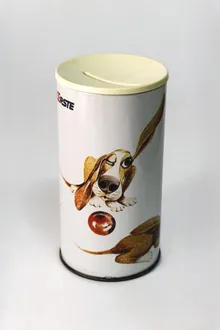
Emil in his original look: Erste tin money box, 1979
From “PS-Hund” to Emil
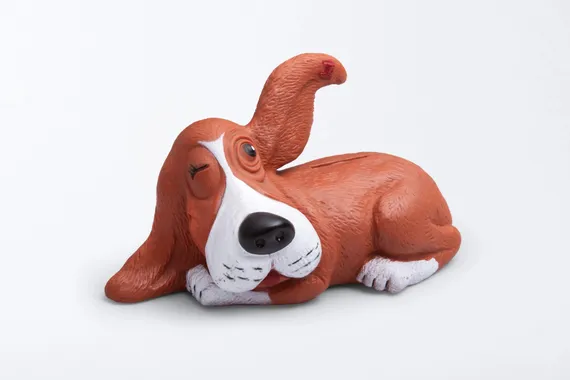
PVC money box, 1987
Internally, the new advertising figure was at first given the rather matter-of-fact name “PS-Hund” (“PS dog”), after the Prämiensparen he was promoting. But he soon acquired a proper name: “Emil”, sometimes also spelled “E’mill” – presumably a play on “Erste” and “Million”.
Instead of the three months originally planned, Emil stayed with Erste for almost two decades. Over that time he evolved from a mere advertising motif into a character in his own right. He appeared on T-shirts and key rings, as the hero of picture-book stories and in comics in Erste’s youth magazine. Emil could be seen on trams and buses all over Austria.
Emil in Life Size
Emil’s life-size appearances were especially popular. Students or staff members put on dog costumes and turned up wherever something was going on: at street festivals and carnival parades, on the first day of school and at the trotting track, at openings and, of course, on World Savings Day.
Saving with Emil
The first Emil money boxes, made of tin, appeared as early as around 1979, though they were not considered particularly child-friendly. In 1986 they were followed – initially on a trial basis – by new models in PVC and plush. The launch was a bumpy one: a storm in Taiwan delayed production, and the plastic version had its quirks – the lock opened too easily and the coins got jammed.
The next generation of money boxes was meant to be more environmentally friendly. Made of ceramic, it showed Emil in front of a yellow-and-red kennel. No fewer than 100,000 were produced, around half of which went to the branches for World Savings Day 1989. In 1995 Emil had a solo appearance once more, as a money box holding a yellow ball between his paws. Towards the end of the 1990s, Emil quietly disappeared from the scene.
Do you have memories of Emil? Of your first money box, a picture book or an encounter on World Savings Day? Do you still have photos or objects? We look forward to hearing your stories! Contact: corporatearchives0984@erstegroup.com