
Christmas Finds from the Archives
Christmas is just around the corner – a great opportunity for us to have a rummage through our collection for festive motifs. Along the way, we came across a few charming pieces.
On a money box from Denmark, a gnome is happily tucking into a bowl of rice pudding. He is a julenisse, a Christmas gnome who helps Father Christmas wrap and deliver the presents. But the little fellow can also be mischievous and play tricks on people. To keep him in good spirits, people leave out a bowl of risengrød for him, a traditional Danish rice pudding with butter and cinnamon sugar.
The julenisse has his roots in Nordic folklore. According to tradition, a nisse (gnome) lived in the barn of every farm. If he was treated well, he helped the farmers; if neglected or mistreated, he might harm the livestock or steal small things. In the 19th century, this farm spirit evolved into the friendly Christmas gnome. The woven heart hanging on the Christmas tree is typically Danish, too. Fittingly, the reverse side of the money box bears the inscription “Glædelig Jul” – Merry Christmas.
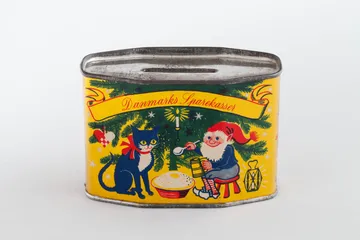
Money box of the Danmarks Sparekasser,
lithographed tin, Denmark, c. 1960
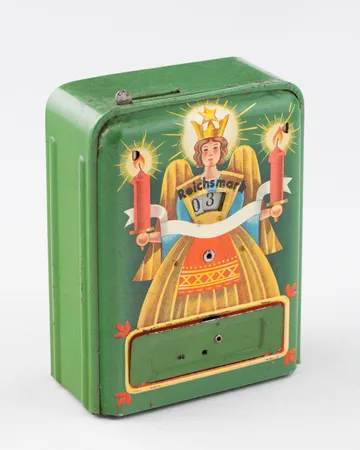
Christmas money box with candle-bearing
angel and coin counter, tin, Germany, c. 1930
This Christmas money box comes from the Ore Mountains (Erzgebirge) in Saxony. It depicts an angel holding a burning candle in each hand, with a crown, a star and golden wings. On the reverse is a snowy village at night, complete with a church, trees, a stag and a hind. The box features a surprisingly ingenious mechanism: it accepts coins of one Reichsmark, and can only be opened once a total of 50 Reichsmarks has been deposited. A counter on the angel’s chest shows how much has already been saved.
This tinplate money box takes the form of a small lantern with a handle. Two of its sides show a burning candle in colourful lithography. Coins are inserted through a slot in the roof, while a lockable flap in the base allows them to be removed. The box dates from around 1900.
This classic ceramic Santa Claus was made in South Korea. With his red coat, white fur trim, rosy cheeks and long flowing beard, he embodies the familiar image of Father Christmas. His large, rounded sack of presents holds the coins.
Quite different from the rotund Santa Claus is this German Father Christmas. His appearance goes back to a famous model: in 1847, the Viennese painter Moritz von Schwind drew “Herr Winter” (Mr Winter), a bearded old man in a hooded cloak, to illustrate a poem by his fellow Austrian Hermann Rollett. The figure went on to shape the image of Father Christmas throughout the German-speaking world.
In American Christmas tradition, reindeer pull Santa Claus’s sleigh. It is hardly surprising, then, that reindeer-shaped money boxes were also made in the USA. This example dates from around 1920 and was produced by the A.C. Williams Company of Ohio, known for its toys and animal-shaped money boxes. The reindeer is made of cast iron and hand-painted in gold. To retrieve the coins, a screw had to be undone. The figure could then be taken apart into its two halves and the antlers.
This brass money box has no festive decoration, but its engraving reveals that it was given to someone named Gert for Christmas 1914. A rooster in relief and an arched frieze decorate the otherwise plain box. It was secured with a padlock, which is no longer present.
Our final piece is a snowman who is already looking ahead to New Year’s Eve. He holds a golden horseshoe between his hands and wears two red-and-white toadstools on his hat. Both are traditional good-luck charms for the new year in Austria. The figure is made of earthenware, coated in wax and sprinkled with glitter.
The team at Corporate Archives wishes you a Merry Christmas, a restful holiday season and a happy New Year!