
"As men, we have a responsibility to
strengthen women’s voices"
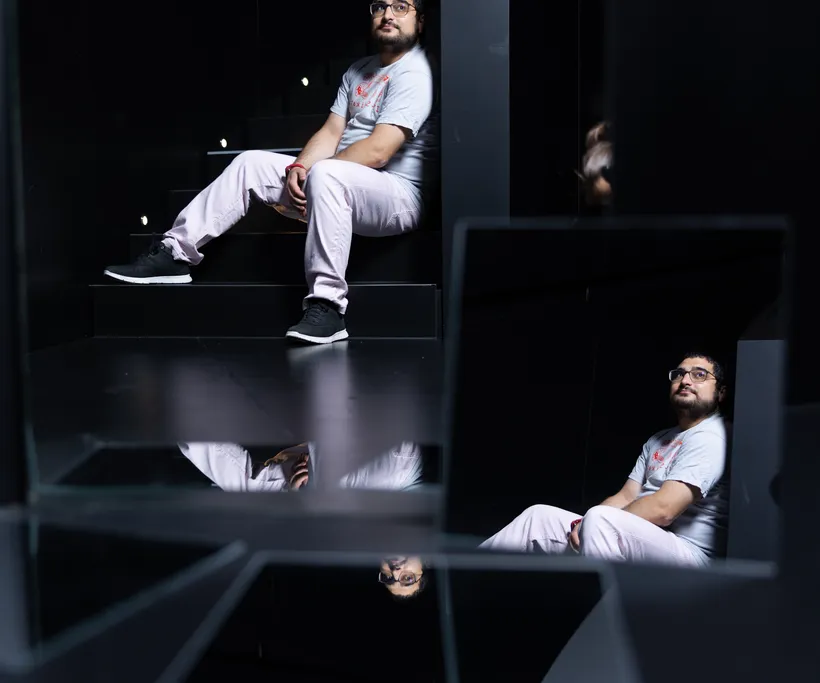
Petar is part of Erste Digital’s Cyber Defense Center and of WoMen in IT – our (almost) female IT network. Equality and awareness about technology risks are close to his heart.
How did you grow up?
I was born in Austria, my parents are from Bosnia, and I have had friends from different backgrounds and cultures around me my whole life. As my parents grew up in a different society, they sometimes had different values and beliefs in comparison to Austrians. As a young adult this was not always easy and at times felt like a culture clash. However, my parents raised me in their mother tongue and supported me in my endeavors wherever they could. For example, I was able to move to Vienna for my computer science study with their financial support. Also today speaking Serbian comes in handy when I’m exchanging with colleagues from the entities in the Balkans.
What do you do in your job?
Daily, I assess our internal systems for vulnerabilities: the network, the applications, and the processes. Vulnerabilities enable potential entries for criminals to abuse our systems. If I find these vulnerabilities, I write a report and notify my colleagues and give them recommendations on how to remediate them. I'm also there if they need consultancy or have questions.
In easy words, I make life difficult for attackers who try to bypass our security. Creativity is crucial in this job because attackers are also very creative in finding and exploiting vulnerabilities. They even take advantage of people by manipulating them emotionally; this is known as social engineering. Using these techniques, they aim to gain access to money, knowledge, or information. Thinking outside the box is a very important skill for this job.
What do you love about your job?
We work with different people in various positions and departments. So, this diversity of challenges, systems, and interactions with people makes my job very interesting. Every day I learn something new. I get to know new people, build good networks, and support colleagues with their challenges. This makes this job very cool. Plus, we are a great team here at the Cyber Defense Center. My job is my passion, that’s why I also spend my free time travelling around the world and visiting hackspaces and going to conferences. There I meet both new and familiar people, exchange various tech insights, and really connect. It’s a worldwide community.
Would you describe yourself as a typical IT guy?
If you think about the stereotype of a typical IT guy, which is an introverted person staring at the computer all day long, that's not the case. I am very outgoing and love to talk to people and network.
You were the first man who is an active member of our mostly female network WoMen in IT. How did you become a part of them?
I visited a couple of their events, because I was very interested in watching the interviews with different impressive and successful women from the company, and getting to know them and their life stories. It was super thought-provoking from the beginning. I used to ask a lot of questions and then later I was approached about becoming a member of the WoMen in IT group.
I think as a man it is really important to support women and give them a stage. IT is not only made for men. We have seen so many examples in the tech world, where a lack of diversity leads to discrimination, exclusion and poor performance. I would say, especially men need more awareness and understanding that less diversity is always a weak point, because we are missing all the diverse perspectives that help us identify problems and create better solutions.
When did you become aware of the topics of diversity and inclusion?
It was my time at university. We had about 20% female IT students only. When I was part of a students’ union and we decided to give away tickets for events and conferences with a zipper system – means for every woman who gets a ticket, a man will also get a ticket. We wanted to achieve an equal distribution between genders. Of course, people started complaining. That was one of the moments when I realized that fairness and equality are not supported by everybody, usually because of a lack of awareness about their privileges.
What would you like to change in the future?
Technologies are becoming increasingly powerful. I really wish that people would become more aware of the dangers of violence and inequality technology brings. I always try to increase awareness about the issues and risks of technology and why privacy is so important. I want people to know what they can do to protect themselves. This topic is close to my heart and that’s why I’m advocating for it.