05.05.2016
Erste Bank Savings and Credit Forecast Q1 2016
Amount earmarked for saving rises by a quarter compared to the previous year
- Every second person already pays by card
- Investment in real estate becomes more popular: 21%
- Planned savings amount increases: EUR 5,500
How Do Austrians Save?
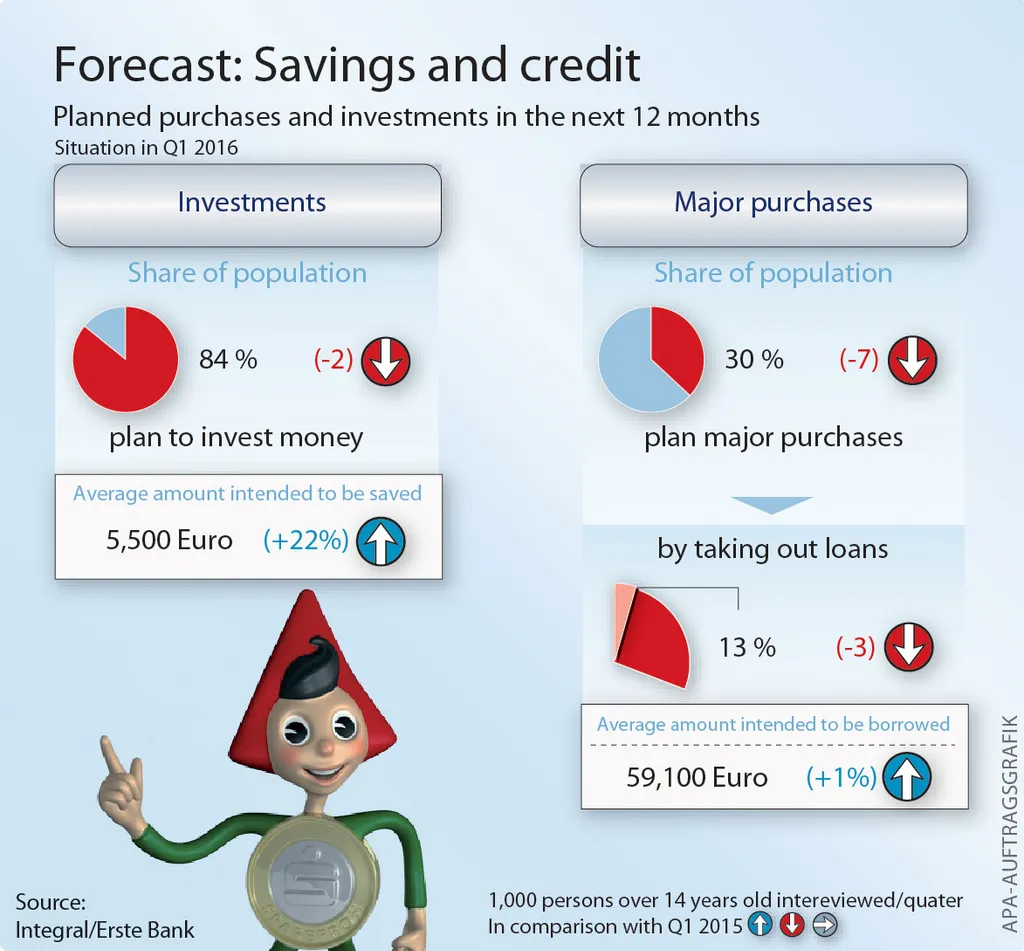
Austrians are eager to save, in spite of low interest rates: According to a study conducted by Integral on behalf of Erste Bank, 84% (+2) of respondents plan to invest money. Savings accounts remain the main form of investment for 57% (-4), closely followed by building savings contracts which 51% (-6) like. The popularity of investing in life insurance policies has declined significantly and currently stands at 37% (-7). Real estate on the other hand is becoming ever more popular: 21% of respondents state that they are investing in an apartment or a house (+4). Investment in securities is of interest for 23% (-2) of Austrians.
Uptrend in Savings
The average amount earmarked for saving has increased by 22% compared to last year and currently stands at EUR 5,500. That is EUR 1,000 more than the amount of just one year ago. “This doesn't mean that people have more money to save at their disposal. But it appears as though many are parking their money and are now pondering how to invest it”, says Thomas Schaufler, chief retail officer of Erste Bank. The actively managed fund You Invest e.g. offers the opportunity to invest in a highly diversified and targeted manner. Its top priority is to achieve a balanced proportion between risk and return. Broad diversification across different asset classes and a systematic investment approach provide stability to the fund's investments. You Invest currently has more than EUR 800 m. in assets under management in Austria alone.
However, major purchases are only on the agenda of slightly less than 1/3 of Austrians this year (30%). Particularly younger people in the 14 to 29 year age group are interested in spending on a big ticket item. 87% state that they will finance these expenditures with their own savings. Only 1 out of 10 Austrians (13%) plans to take out a bank loan for a large purchase – that's a decline by 3 percentage points compared to one year ago. In terms of the average amount intended to be borrowed, no big changes are noticeable compared to the previous year. Austrians plan to borrow EUR 59,100 on average in order to finance bigger investments (compared to 58,700).
Payment by Card is Gaining Ground
The debate over the abolition of cash in the EU has left its mark on Austrians as well. What do Austrians believe they will in future prefer to use for paying in shops? For 69% cash is still ranked at the top, however, every second respondent (55%) says that they are already using either ATM cards or credit cards. Around 5% can currently imagine to increasingly use their mobile phone for payment in the future. Most Austrians employ a combination of different payment methods. “We support absolute freedom of choice. As a bank, we are making new technologies available, but our customers will decide which ones to use”, Thomas Schaufler explains.
About the study: Integral has interviewed 1,000 Austrians (representative of Austria's population above the age of 14) via telephone and asked them about their plans with respect to forms of saving and investment, as well as about their financing needs. The survey has been conducted in the 1st quarter between 25.2.2016 – 15.3.2016. Unless stated otherwise, comparative figures refer to same quarter of the previous year.