Upheavals & New Beginnings (1918–1945)
1925
The first World Savings Day is celebrated in Austria. After the difficult years of the global economic crisis and inflation, the aim is to encourage people to save again, for example through small gifts or higher interest rates.
From the outset, the educational aspect is at the forefront: children and young people are to be familiarized with the idea of saving at an early age, and thrift is to be promoted as a social virtue. For the economy, building up capital for investment through savings deposits is central.
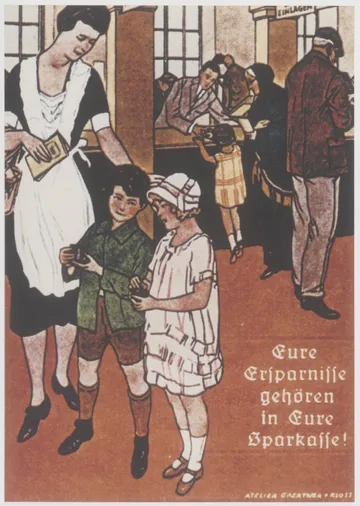
Advertising poster for the 1st World Savings Day,
1925
Late 1920s

Nighttime photograph of the Wieden branch, Suttnerplatz 6
In 1927, Erste österreichische Spar-Casse openes branches on Mariahilfer Straße and Hietzinger Hauptstraße. The reason for this is not only the location activities of its competitors, but also the newly awakened virtue of saving. Three years later, there are already 14 branches in Vienna. The business is limited almost exclusively to savings deposits.
1938
With the “Anschluss” of Austria to Nazi Germany in March, the Austrian savings banks are incorporated into the German savings bank organization.
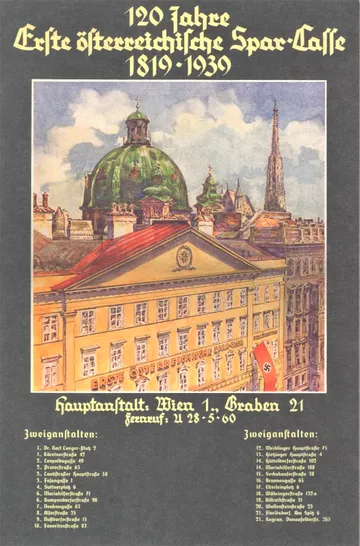
Calendar for the 120th anniversary, main office
with swastika flag
1939–1945
The banking and credit industry is placed at the service of the Third Reich, primarily to finance armament and war. In 1941, the state-sponsored “Iron Savings” program is launched. Credit institutions, as well as insurance companies and social security providers, are required to invest savings deposits in government bonds, which are used to pay for armament expenditures.