Reconstruction & economic
recovery (1945–1980)
1955
Erste österreichische Spar-Casse is the first Austrian credit institution to present a socalled reconstruction balance sheet, a kind of final balance sheet for a ten-year restructuring process. It reflects Austria's strengthening economy and savers' growing confidence in credit institutions. Savings deposits account for 61% of the balance sheet total.
Reconstruction balance sheet Erste österreichische Spar-Casse December 31, 1954
1957
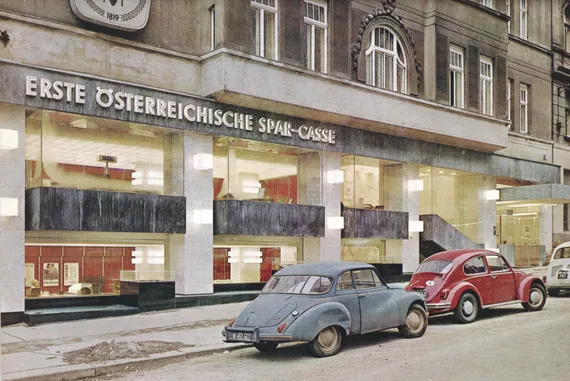
Modern branch on Nußdorfer Straße, 1960s
A ten-year program of modernization and expansion of the branches begins. By 1962, 19 new branches have been opened. Now safes, passbook deposit services, and safety deposit boxes can also be offered. The branches play an important role in contact with schools for school savings programs.
1960s
The Erste österreichische Spar-Casse modernizes its operations. Mainframe computers are purchased for the first time to handle account and credit transactions. In 1963, the BULL GAMMA 30 electronic data processing system is installed at the head office, followed by a second one three years later.
In 1968, the computer center in Neutorgasse is completed. It houses the IBM 360/50 supercomputer, which enables remote data transmission. All branches are connected by telephone, allowing immediate bookings to be made on the various accounts.
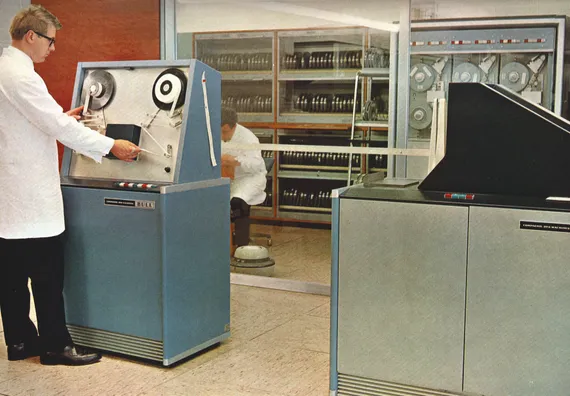
Data processing/punch card reader, 1966
1979
Erste österreichische Spar-Casse becomes a universal bank, meaning it can conduct all types of banking transactions. Previous restrictions, such as the ban on issuing its own securities, are lifted. Business activities that were previously only tolerated, such as leasing and international operations, are now officially permitted. Savings banks are now also allowed to open branches outside their traditional region.